



Beauty from order springs.
—William Kink
Something was wrong. I couldn’t put my finger on it. What could it be?
Most of my graduate students were Generation Ys (aka Millennials)… born after 1982, raised in a digital world. Slogging through various credentials and degree programs at the end of their long workdays made it difficult for them to focus. The cares and worries of their days came with them every week. Their commutes, their own course preparations and classroom management challenges, and their responsibilities at home hung around them like Marley’s chains in Dickens’ Christmas Carol. For any teacher, it’s a problem. All students are difficult to focus, no matter what their age. I had decades of experience, but it wasn’t helping. Things weren’t going well.
***
To counter the distracted hum and glazed looks, I filled a large easel at the front of the room with “presenting questions” to jumpstart the evening. Written in careful cursive, I reasoned the sheets would become part of the class record and help them remember what we were doing. As weeks passed, the room walls filled with topics from earlier sessions. It was like living inside a house with walls of grace, looping Palmer writing. It seemed like a good idea—sort of like “dinner special” easels in restaurant waiting areas. It wasn’t working. Students rummaged in their backpacks, pulled out papers, laptops, books, talked to each other, or gazed at the clock, willing it to advance. The same few people opened every discussion. Midway through the term, a 30-something middle school history teacher approached me as I was putting the finishing touches on my easel questions. Twisting his hands, he lowered his eyes. Gesturing at the sheet behind me, I beamed, “Hi Mark. Would you like to add something?”
Shoulders hunched, he sighed. “Some of us can’t read your handwriting.” He rushed on, “We only print or keyboard. We didn’t learn cursive.”
I’m not sure which of us was more embarrassed. My cursive writing days at school screeched to a halt. It was 1999. I converted to block printing. Class discussions perked up. I took down the posters around the room, rolled them into a fat cylinder, and propped them behind my office door. I was the only one who missed them.
***
Cursive writing has become a quaint historical artifact, joining milkmen, landline telephones, newspaper delivery boys, even newspapers themselves. Schools devote little, if any, time to it. Many states no longer mention it in their curriculum standards. In spring 2011, the Indiana State Department of Education sent a letter to all its families—beginning the next fall, public schools would no longer teach cursive writing. However, students would be expected to be proficient in keyboarding.
Three arguments are carrying the day: everyone works and plays on keyboards now; standardized test preparation takes too much time to give up precious minutes to handwriting; and schools reflect a society which now believes writing is both difficult and pointless. Difficult? Maybe. Pointless? No.
***
I can still see my grade school blank newsprint books with their mottled black covers. Fifty empty pages, with alternating solid and dotted blue lines like freeway lane markers, filled with my daily handwriting efforts. The books stacked up in our storage cubbies, testimony to our progress. Penmanship lessons were different—a change from the rest of the curriculum. The loops and tails, chubby circles, flourishes, slants that made whole lines look like Radio City Music Hall dancers doing high kicks, were a tangible link between what I was thinking and what I was doing. Half a century later, holding a pencil above blank paper I still feel my brain shifting… lining up like a golfer before a putt.
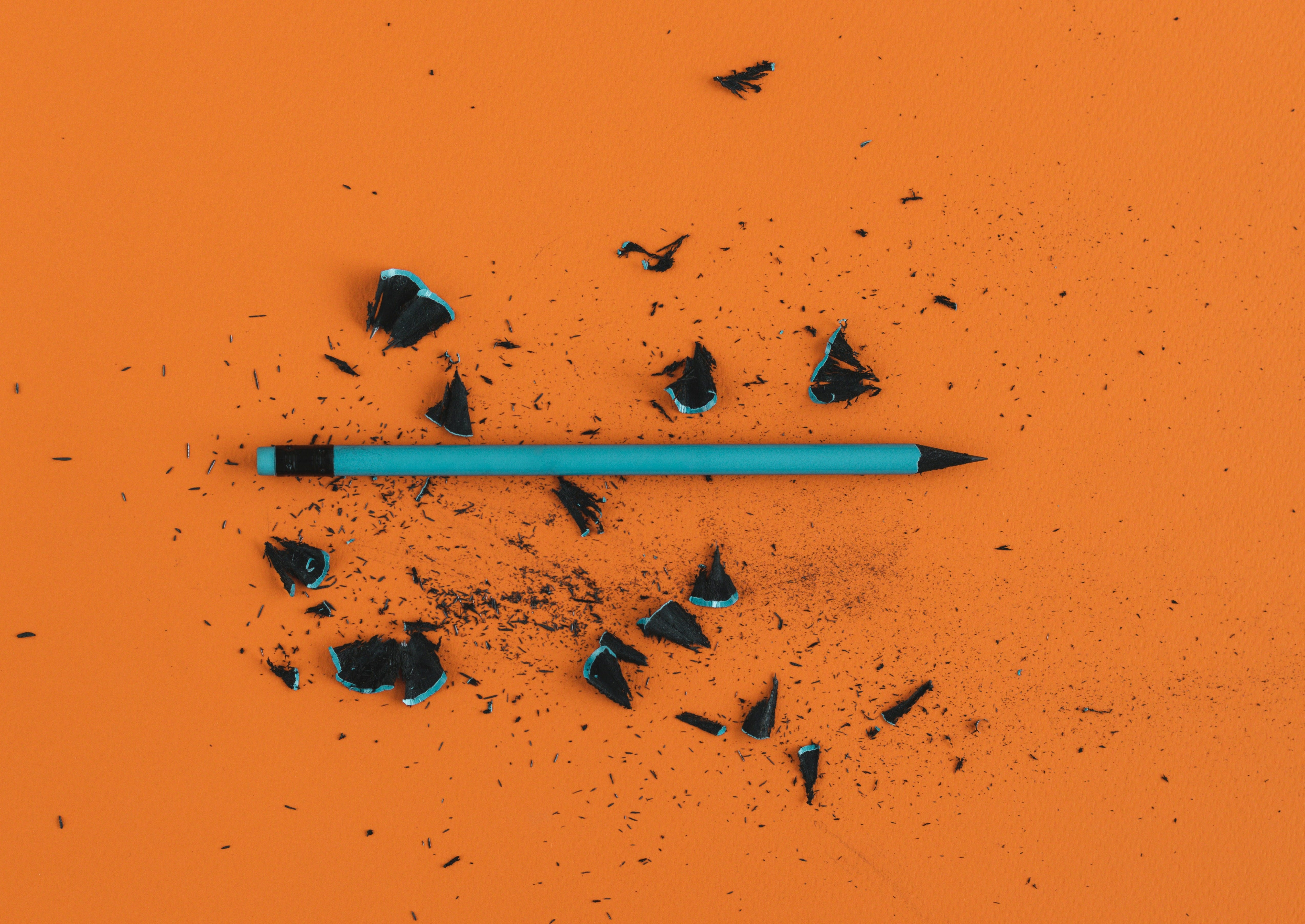
The imperceptible hum of the computer with its musical greeting and blue screen evokes a different response—more detached, more mechanical. For me, the pencil is more intimate than the keyboard. When ideas are fragile and just taking shape my brain and my heart don’t want to be distracted by a screen. Afterwards, the clever computer makes shaping easier. But there needs to be something to shape. Every important paper, letter, project—including my dissertation— began with a pencil. They still do.
***
Learning from students is one of the great gifts of teaching. It’s also a survival technique. James Russell Lowe was right when he observed, “New occasions teach new duties.” I bought colored markers and devised a kind of print and icon system they understood immediately. Without the cursive posters hanging around, they began to create their own discussion questions. To me, the new easel sheet markings looked like drunken footprints staggering across a sandy white beach. The students, on the other hand, saw them as information they could access at a glance.
…schools reflect a society which now believes writing is both difficult and pointless. Difficult? Maybe. Pointless? No.
I miss cursive writing. But when I find myself getting maudlin about its virtues, I remember my favorite Melville story, “Bartleby the Scrivener—A Story of Wall Street.” In it, the complexities of the bond between individuals and society unfold in a law office where Bartleby spends his day copying documents. The lawyer narrator says:
At first Bartleby did an extraordinary quantity of writing. As if long famishing for something to copy, he seemed to gorge himself on my documents. There was no pause for digestion. He ran a day and night line, copying by sunlight and candlelight. I should have been quite delighted with his application, had he been cheerfully industrious. But he wrote on silently, politely, mechanically.
It is of course an indispensable part of a scrivener’s business to verify the accuracy of his copy, word by word. When there are two or more scriveners in an office, they assist each other in this examination, one reading from the copy, the other holding the original.
It is a very dull, wearisome and lethargic affair. I can readily imagine that, for some sanguine temperaments, it would be altogether intolerable.
For example, I cannot credit that the mettlesome poet, Byron, would have contentedly sat down with Bartleby to examine a law document of, say five hundred pages, closely written in a crimpy hand.
Finally, Bartleby rebels, responding to every request to copy or check his writing with the famous words (for every student who reads the story), “I prefer not to.”
The narrator’s world is forever changed as he tries to understand this assault on the conventional order. In the same way, the end of cursive is a reflection of a changing society… a society in the throes of what historians William Strauss and Neil Howe call “The Unraveling.” It is a recurring generational pattern that will result in a redefinition of how we work, live, play, pray, communicate.
Bartleby’s defiance helps the lawyer redefine his world. It expands beyond his workplace walls to include a man who wants to be acknowledged for other than his ability to copy documents.
***
For my students, cursive writing was a barrier. For Bartleby, a prison separating him from life beyond work. For me, a catalyst for thinking. Even more, the repetition of those childhood drills led to pride in something created by hand…built on bedrock of time-consuming labor. Practice had other benefits too. One was the lesson that success depends more on perseverance than speed. The computer works at lightning pace. My students turned out papers in record time. But reading them, and later reading disjointed graduate papers in other schools, I think of Samuel Johnson, who once said in a different context, “What is written without effort is in general read without pleasure.”
***
Coherent arguments need structure. So do engaging paintings. In art, selective repetition adds unity to compositions. Cursive writing was good practice for both. I am glad I have a computer—sleek, fast, a universe of information at my fingertips. It does almost everything, as does its newer next-generation competition: convenient handheld devices destined to replace desktops.
Almost everything. The idea seeds for essays or paintings or letters to friends don’t happen on the screen. They begin somewhere more mysterious, more idiosyncratic, more intimate. They begin in the subconscious, percolating up, emerging half-formed, needing polish. Technology is good for polish.
New ages use different tools for problem solving, for creating, for communicating. Pencils belong to yesterday. DaVinci sketched with a pencil. Steinbeck and Hemingway wrote their manuscripts with them. Thoreau manufactured some of the best in New England himself. Edison always kept one in his pocket. I’ve got a stubby pencil in my pocket, too. The eraser is worn down. When I am stuck on a thorny problem, I doodle handwriting shapes in the margins of my tablet or on scraps of paper. It helps every time.
Every important paper, letter, project—including my dissertation— began with a pencil. They still do.
As chief operating officer at Facebook, Silicon Valley power broker Sheryl Sandberg is number two in command at the world’s largest social network. Every day she brings to work a Windows laptop computer, an Apple iPad, Android and Blackberry phones. “I try everything,” she says. “I have over 3000 friends to communicate with. My CEO, Mark Zuckerberg, prefers instant-messaging chat. My sister calls on a cell phone. My husband prefers e-mail.”
Students who compose on keyboards tell me when they are stuck, they switch screens, check their email or Facebook page, text a friend, or spend time playing games.
The time may come when contemporary connections become as suffocating for modern life as Bartleby’s law office existence. Meanwhile, I’ll sharpen my pencil. Someone may need to borrow it if there is a power outage.
There will be.


