



The cemetery is an open space among the ruins, covered in winter with violets and daisies. It might make one in love with death, to think that one should be buried in so sweet a place.
—Percy Bysshe Shelley, 1792-1822
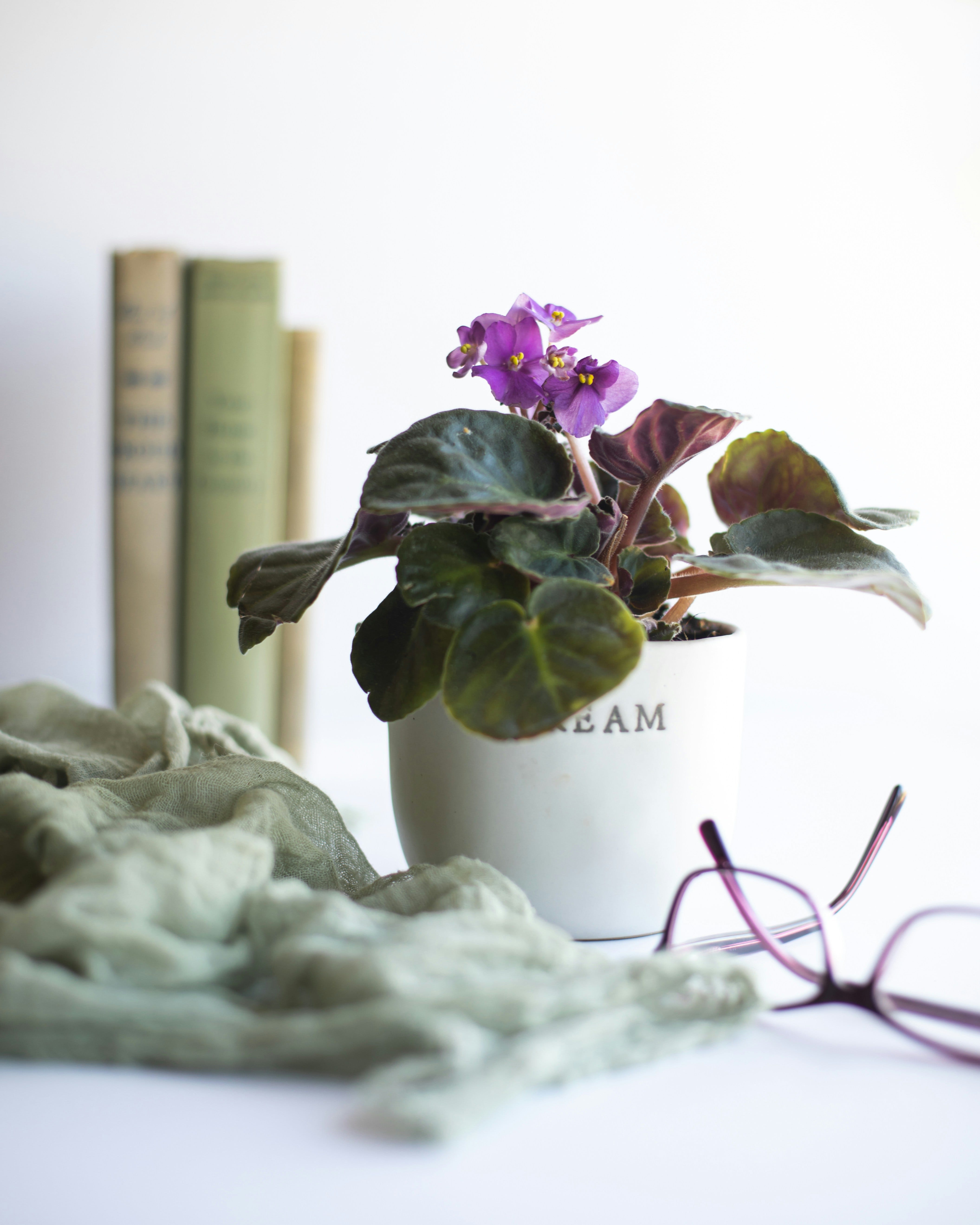
Eager for a new surface to paint on, I enrolled in a glass-painting seminar. Its use in decoration has a long history dating to early Egyptian culture. By the tenth century, it had become part of medieval architecture. Courting mirrors with decorated glass panels were among the prized exports when trade with China was flourishing. The techniques are complicated.
The results are beautiful. The seminar subject was dimensional violets on five small panes of window glass. Part of the lush bouquet was painted on each slab. The objective was to teach depth and perspective by having us mix our own shades of blue and purple, then combine the design with colors that magnified depth.
Some of us added crimson to get brighter violets. Others added raw umber to create almost black purple. I mixed blue and purple equally to create a third shade. My project was conventional, careful and complete — until I looked at some of my classmates’ efforts. Students who ignored the directions did the most arresting designs. Mixing different colors altogether and deconstructing their bouquets, they had stems and outlandish flowers wandering away from the primary design in clever alternative patterns. When the glass was stacked, they had created unique, provocative arrangements using their imaginations. I accomplished what the teacher expected. Yet rather than satisfied, I was disappointed. It was some years before I understood why.
Not long ago, New York’s American Folk Art Museum was considering dissolving itself and dispersing its art to the Smithsonian. At the last moment, its trustees and the Ford Foundation rescued it. New York’s Cultural Affairs Commissioner said, “This is a wonderful outcome. People are increasingly recognizing the value and the excitement of folk art, outsider art.”
That’s good news. Being able to look back is important, but not enough. Old art, whether magnificent or mundane, is always the raw material of new art. The artist’s job is to build on it or transform it, not offer up comforting familiarity as a talisman against the void. That was the problem with my glass project.
It was a bridge backward. Much later, painting became a path forward. The eclectic, defiant, thought-provoking, appealing violet creations I admired grew from being able to see something that wasn’t there before. Some of us took a simple design from “outsider art” and made it new. I did not. My flowers were pretty, predictable and pedestrian. But I learned. I spent a year working with dimensional designs. Every project grew more interesting, more playful, more original. I began to understand what I could do if I looked beyond the obvious.
The violets are gone now, broken in one of our household relocations. Their lesson remains. New endings can come from conventional beginnings by using old tools in different ways.
The only energy it takes is the courage to use our imagination. It’s the energy we need in a world where the road has grown rockier and our declining standard of living is called “the new normal.”
Stacking the glass in a different order. It’s a good idea. It may fail, but we won’t know unless we try.
One January years later, I scanned my new spring term last period class list, fearing the rumor I heard in the faculty room was true. It was. One of the most disruptive high school seniors was in my elective, “The Short Story.” He made his first appearance by swinging into the room off the doorjamb like Tarzan dropping from a tree. Six feet four inches of uncontrolled energy, he electrified the all-boy class with his defiance, his arrogance, his slick BMW in the student parking lot and his athletic scholarship to the University of San Diego if he passed every class the last term.
The first week was a nightmare. Thirty teenage boys after lunch. I was trapped in a movie — “Ferris Bueller’s Day Off” meets “Lord of the Flies.” The ringleader senior spent most of his time squirming in desks too small, sending paper airplanes soaring, sabotaging class discussions, sauntering around the classroom at will.
Weeks dragged by. Each worse than before. Early one Monday, I was standing on the large shag entry rug at home, calling last instructions to my own children before we headed separate ways. Looking down at the blue and white pattern, I got an idea. I dragged the rug to the car and headed to work. Not the least of my nemesis’s problems was he was uncomfortable in the school furniture.
Old art, whether magnificent or mundane, is always the raw material of new art. The artist’s job is to build on it or transform it, not offer up comforting familiarity as a talisman against the void.
Sixth period arrived. I suggested if someone was too tired, too distracted, or too stressed to sit in a desk, they could sit on the rug… as long as they tracked with the class. It had worked when I was a preschool teacher — why not try it with high school seniors? Many of them act like overgrown preschoolers themselves. There’s even a name for their behavior — the Peter Pan Syndrome. Like Peter, growing up is something to be avoided. Many adults they know don’t look like they’re having much fun. No point in rushing the future, they think.
The rug was a curiosity. Most students thought it was uncool. The troublemaker did not. He stretched out like a resting lion. The effect on the class was stunning. Everyone was calmer.
The final project was to write a short story. He wrote about a magic carpet that took a boy to a place where people didn’t have so many rules or expectations. At the end, he added a note — “Your class wasn’t so bad after all. Thanks. I’d like to get you a present.”
I suggested violets.


