



The purest form is still the shape / That mist inhabits, and dissolves, / Trampled snow is the only Rose.
—Yves Bonnefoy
FRAGILE. FLOWERS. I could read the bold words on the tall brown and green box leaning against the front door as I got out of the car.
Misty-eyed, I maneuvered the long awkward shape to the kitchen. Behind the shipping label was a card which read, “To my daughter. Love, Old Dad.” Inside were flowers—roses and lilies from my faraway 90-year-old father, sent for Valentine’s Day. Among the many gifts he showered on the extended family, flowers were among his favorite. He sent them to all of us—for new babies, graduations, birthdays; for successes, for encouragement, for loss of beloved pets, for broken hearts.
***
Dad had a standing order with a Virginia florist for deliveries to Mother’s grave at Arlington National Cemetery for most holidays and her birthday. December was their anniversary month. Every year the florist sent pictures of beautiful red and green arrangements nestled against the white tombstone. A 56-year love story, still alive in flowers more than a decade after her passing.
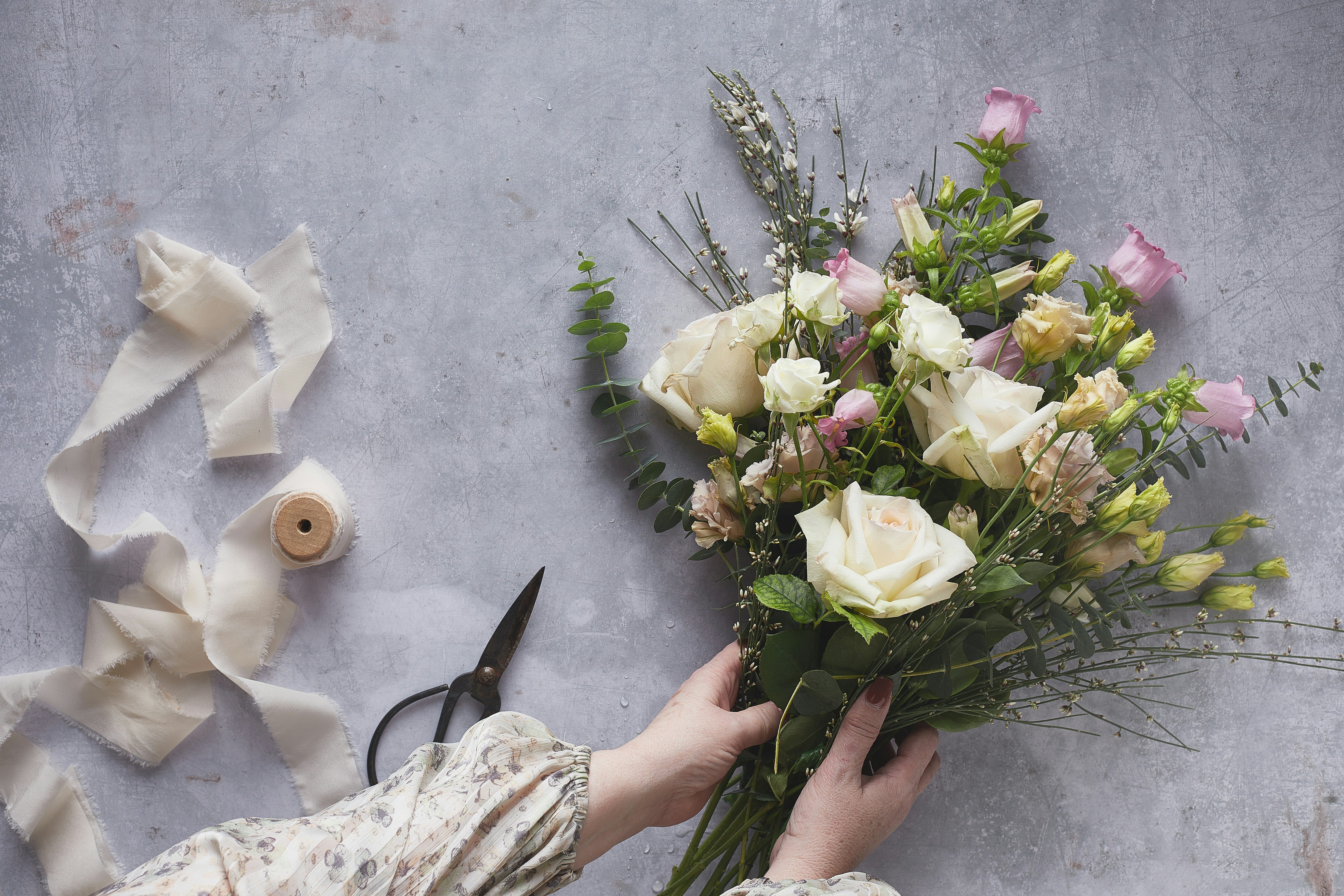
Tucking the dozen multi-color blooms in the white ceramic vase included in the delivery, red hearts dancing around its base, I stepped back to admire my handiwork. The flowers brought both my parents into view as if they were in the kitchen with me. They were. They came in on the rose petals.
***
After my first china painting session ended, I registered again. Soon, I was signing up for the afternoon and night class. Wednesdays became synonymous with painting. I took a university academic appointment with the understanding that I wasn’t available any Wednesdays. The routine was a metronome balancing two forces—a conventional activity people understood and a peculiar activity people overlooked. I didn’t mind. In the first I was the teacher. In the second I was the learner. Learning made me a better teacher. It always does.
The painting instructor introduced new subjects every term. Landscapes, still lifes, birds and animals, vegetables, fruits and flowers of every variety—except one. Roses. No matter how often we asked she replied, “You’re not ready.” Eventually, we chose our own compositions. Around the classroom people hunched over everything from enormous bowls to umbrella stands to lamp bases to small tables to dishware. Everyone had a favorite subject: holiday designs, portraits, horses, hummingbirds, exotic animals, water lilies, leaf studies. Just no roses.
***
Six years passed. The teacher decided we had become “advanced beginners,” capable at last of painting roses, the “queen flower” for porcelain artists. We tackled them first in a summer session at her home. Built in the 1920s, it was a Wind in the Willows sort of place with a steep roof and small diamond-shaped leaded glass windows. The narrow driveway—two parallel cement ribbons—led to the parking yard and weathered barn behind the cottage. Two blocks from Main Street, it had somehow escaped the present. It was a perfect setting for an old-fashioned art.
***
The four of us who gathered in the tiny “library” were eager to jump right in. But the first afternoon was devoted to sketching, listening, and simply looking at the beautiful roses that lined the narrow driveway beside the house. Scientists estimate roses have been blooming on Earth for 60 million years, outlasting dinosaurs. They’ve been used for thousands of years for medicine, perfume, and cosmetics. Confucius wrote there were 600 books about roses in his Chinese emperor’s library.
As I walked back and forth on the narrow drive, burying my nose in the parade of red, pink and yellow flowers bursting on bushes taller than me, I remembered the book of Isaiah promising in Chapter 35, “And the desert shall rejoice and blossom as the rose.” My mind skipped on to Romeo’s longing, “What’s in a name? That which we call a rose / By any other name would smell as sweet.” It was a speech I used to set up a debate on the power of words with my own students. In the summer sun the flowers needed no name. Their beauty spoke for itself.
We met every week that summer to paint roses—old ones, wild ones, dying ones, enormous open ones and tiny closed buds. Red for love, yellow for remembering, white for purity. The instructor showed us how, although rose varieties look different, they share a general shape in regard to outer petals. Some are more pointed, some are round, and some are very irregular. But if you look beyond the obvious, the shapes fit into three circles. Lightly sketching the perimeter, then painting the heart, turning it upside down to paint the shadow side first and then the light side, creates a foundation for the composition. It was a roadmap for beginners. Taking something complicated and making it easier to understand was something I appreciated. It is something many teachers cannot do.
Once they master roses, some china painters never paint anything else. It is easy to see why. Their beauty, their fragile lives, their thorns… perhaps nothing else captures life so well. Taking time once a week to concentrate so completely on something so beautiful was just one gift of painting. Another was the link to what I saw as the longing of people to make their world more gracious, more beautiful, by growing a flower that speaks without words. The teacher planted her roses 40 years before. The first one was a gift from her only child. The young boy who gave her the bush one Mother’s Day was now almost 50 years old. But when she talked about her roses the affectionate son he had been was back.
***
The French poet, Yves Bonnefoy, wrote of Shakespeare, “I should say that, in his work, I see no opposition between the universal and the particular.” In his own work, he has devoted himself to what he calls the universal “here” and the eternal “now.” Painters are devoted too—to using their tools and understanding of shapes and patterns to capture images too soon gone. They are images connected to their heart.
Bonnefoy wrote in “Passerby, These Are Words”:
And for you who now move on, pensively, / Here becomes there without ceasing to be.
From my father’s house in San Diego to my doorstep in northern California or the quiet Virginia cemetery 3,000 miles away, flowers bring the same message—across time and distance, we are still together.
I paint rose compositions six or seven times a year. I give most of them away…my version of sending flowers. The projects are a way for me to be in the present and the past at the same time. I was wrong thinking my instructor’s house was one time forgot. It wasn’t forgotten—it was timeless. The greatest lesson that summer wasn’t inside the house. I nearly walked right by it along the drive.
Knowing where to look. Harder than it seems. Always worth the effort.


