



In anything at all, perfection is finally attained NOT when there is no longer anything to add, but when there is no longer anything to take away.
—Antoine de Saint-Exupéry
No silence is as uncomfortable for a teacher as the space between question and answer. We imagine our discussion starters will lead to waving hands as students jump in, eager and prepared. When that doesn’t happen, most of us answer our own questions. Research says we wait less than a second when we’d get better answers if we waited between three and seven. Seven seconds? I wasn’t willing to risk it. Seven seconds in a high school classroom is an invitation to chaos. I asked and answered so many of my own questions I felt like an actor playing twins — first one personality, then another. Lindsey Lohan reprising the Hayley Mills role in “The Parent Trap” had nothing on me. The routine left me exhausted, students bored observers.
I had two problems. First was the idea that an easy question with quick answers was learning. It’s not. It’s recall — something useful but different. The second was my aversion to empty space. After too many years of lessons that looked like game show preparation, through trial and error my questions improved. I stopped asking for short, recall responses in favor of those that required actual thinking.
A math teacher helped me with the space problem.
***
I began teaching in a school that used teacher peer review. A math instructor asked me to observe him. He chose “the difference between nothingness and nothing” for his algebra class. I listened to his lesson. He began by holding his hand straight out in front of him, fingers spread apart like a determined school crossing guard. “What do you see?” he asked. Students smirked.
“Your hand.”
“What else?”
“Your fingers,” they said.
“What else?”
The class grew uneasy. “What about the space between my fingers?” he prodded.
“There’s nothing there,” someone called.
Beaming, the teacher said, “Correct. And that’s today’s topic. Nothing.”
The students were intrigued. So was I. It gave me an idea. Not about his teaching. About my own. Maybe space and silence weren’t a problem. Maybe they were an asset.
At least 1,500 years ago, nothingness found its place in arithmetic as the number zero. Trivial as it seems, it enabled us to express numbers more clearly and easily than ever before. A thousand years later nothing made its appearance in arithmetic, and it was not anything like nothingness. Nothing was named the null set. It represents in arithmetic what a virgin canvas and blank sheet of paper represent in painting and writing: latent being. With the null set, mathematicians have been able to show how every number known in arithmetic can be created out of nothing.
I began to think of the lag time between questions and answers as a null set. The gap became an asset. When they had time to think, to create, to test their ideas in their heads first, student answers extended discussions. They owned them. They defended their ideas.
***
I began insisting on space. I was no longer the single actor playing multiple roles in a slow movie. We might be uncomfortable, but no one was bored.
In painting, I faced a similar problem. I didn’t appreciate empty space. Every china blank made me long to fill it up. Classes focused on “subjects” — not on emptiness. Every project became a playground for not only what I was painting, but for techniques I learned. The more techniques I encountered, the more cluttered the paintings became.
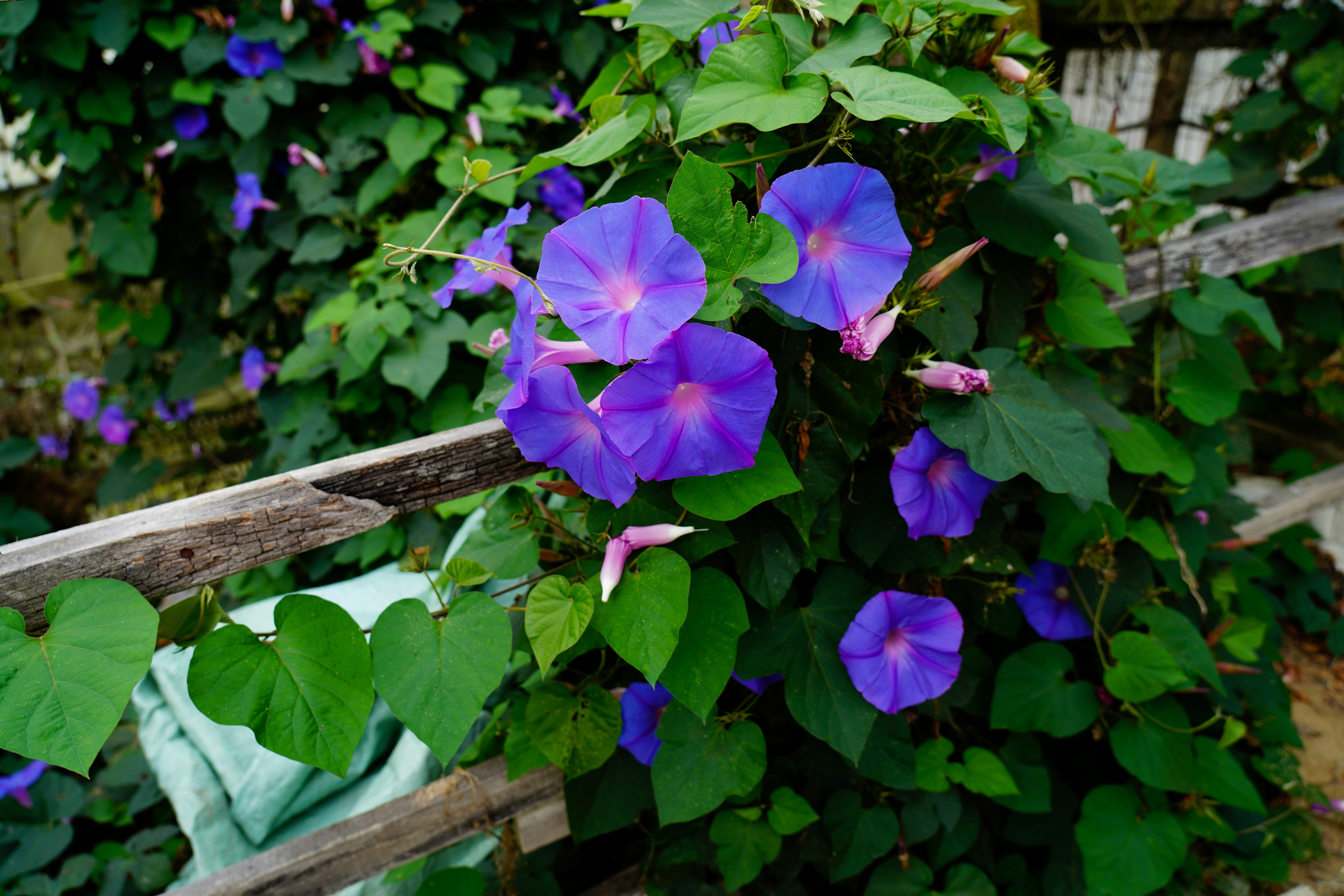
After five years painting porcelain, I signed up for a one-week seminar with a traveling teacher. Her topic was morning glories. We painted eight hours a day. The blue and maroon flowers exploded across a 16-by-16-inch serving tile. Larger than most things I painted, I was intimidated by the space. I added border scrolls, lattice designs, dots and dashes. They looked like garden pests chasing the flowers. I told myself they were whimsical. I filled up every empty inch.
***
The instructor raised one careful eyebrow. “Your subject shape is good. But you’ve forgotten the shadow shapes and negative space where there is nothing. Without them, your work suffers. Stop concentrating on the subject. Look beyond it.”
The next day she brought three separate flamingo pictures: a flock, two facing birds, and four birds looking left with different neck poses. She also brought a poster on which she had written:
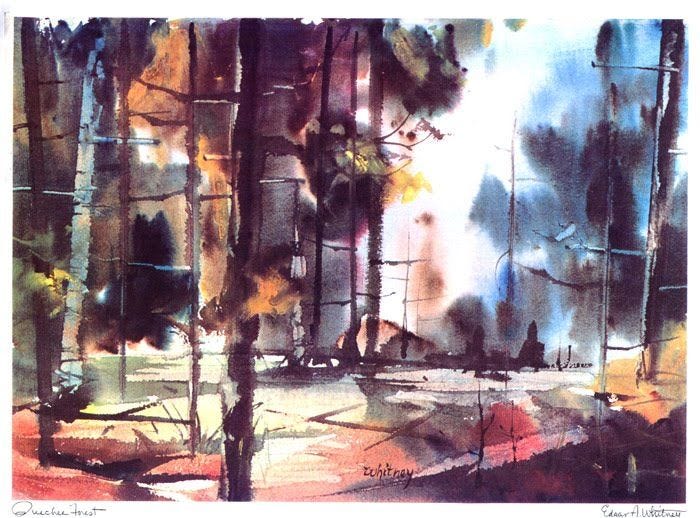
EXCLUDE THE UNNECESSARY — “Be ruthless in eliminating any color, texture, line, value, shape, size, or direction that does not express the subject.” — Edgar A. Whitney
We debated the bird pictures. Using Whitney’s criteria, the four birds was the powerful image. Beautiful negative shapes appeared around them. Whitney, an American watercolorist who died in 1987, was famous for explaining how to put any design, any subject, any style, on any surface and create a unified image. After his death, one student wrote about a workshop she took with him, “I started to paint instead of just applying paint to paper.” The morning glory workshop was that turning point for me.
Every day began with a photo analysis. One day the opener was two pictures titled “Pink Flowers.” The first was a green lawn with an azalea border. The second was a close-up of several blossoms against a muted background. We got better and better at recognizing the power of selection, the power of space. “Including everything you see is easy,” the teacher said. “The lawn and flower picture should be called ‘Garden.’ The flowers are secondary. Decide what the focus is, then make it happen. Don’t weaken or distract.”
I started a new morning glory tray — no scrolls, no borders, no clever dots and dashes. Added shadows. Used negative space. My flowers were no longer being harassed. Neither was the viewer.
It was a risk. Risking something I was comfortable with for the reward of doing something different. Something better. Something with more room — to breathe, to grow, to flourish with fewer obstacles blocking the way.
***
Nothing has become increasingly important for me. It is the space where ideas pop up, problems find solutions, worry recedes. Creative energy, like nothing, isn’t anything if it isn’t potential. It is one of the best parts of being alive. In this sense, the human mind is the real null set; the mathematical version is a subordinate entity created after the mind’s self-image.
Most of us value “busy” above all else. Busy equals productive. Busy equals important. There is another way to think about it. Busy can disguise, deflect, distract, delay. When people call me they often ask, “What are you doing?” If I say “Nothing,” they plunge ahead. But nothing IS something. Without it math doesn’t work. Paintings suffer. So do people.
John Updike said, “What art offers is space — a certain breathing room for the spirit.”
Morning glories remind me.


