



The eye sees only what the mind is prepared to comprehend.
—Henri Bergson
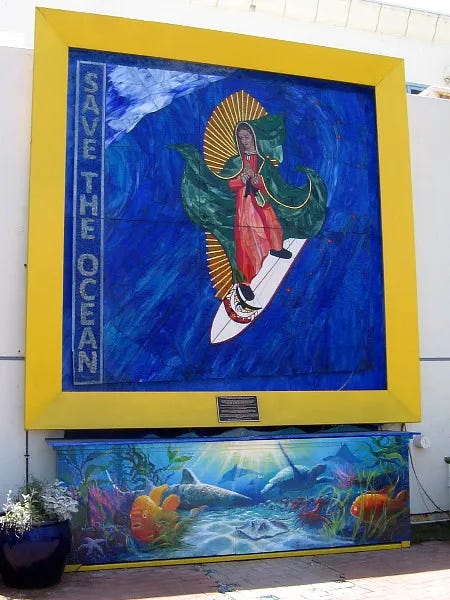
A surfing Madonna appeared just before Easter weekend 2011 in Encinitas, California. Artists disguised as construction workers affixed a striking mosaic of the Virgin of Guadalupe riding a wave to a wall under a train bridge. It technically was graffiti that should be removed under the law.
But the surfing Madonna’s beauty drew a mass following. City officials spent thousands of dollars to hire an art conservation agency to find the best way to remove her without causing damage. Local opinion was split. Was it art or was it vandalism?
The answer is neither. It’s the wrong question. Both art and graffiti are about communicating.
***
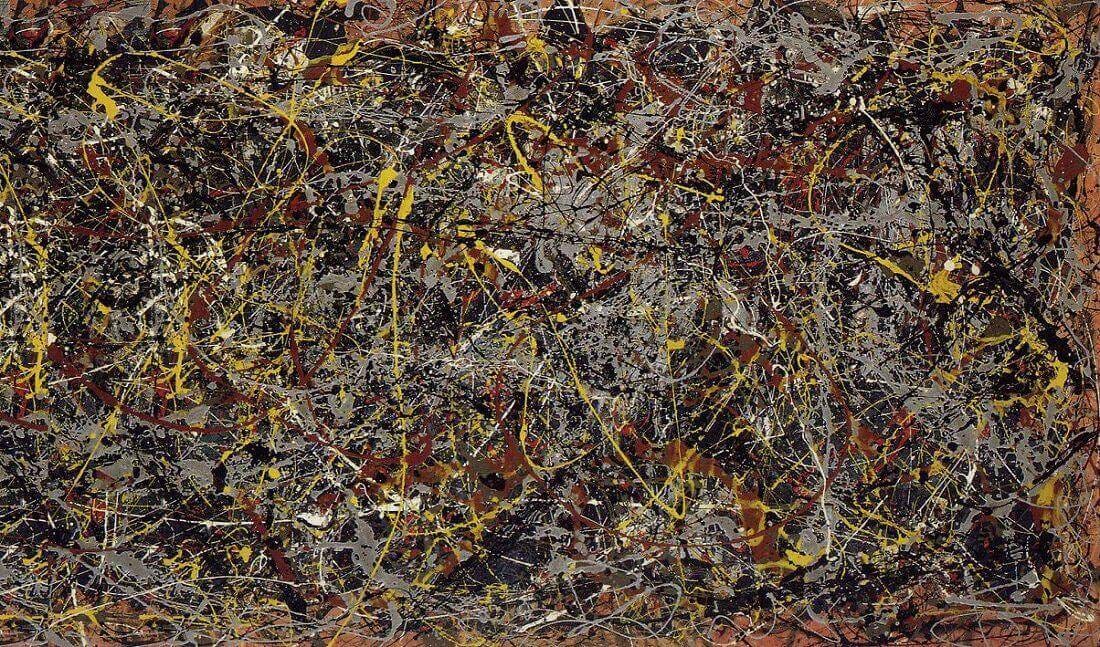
Jackson Pollock is an example. After repeated expulsions from Manual Arts High School in Los Angeles, he dropped out and moved to New York, where he enrolled at the Art Students League. In 1945, in a rejection of what he called “the usual painter’s tools,” he began working on the floor. Dripping paint from a stick or stiff brush or pouring it right from the can, he began to work around the canvas, putting the full force of his body behind the flowing movements of his arm.
The result was a tangle that tracked the physical act of painting. He used unorthodox materials—industrial enamel, sand, gravel, and plumber’s aluminum paint. As he worked, his cigarettes and the contents of his pockets spilled out and adhered to the tacky surface.
Although Pollock was initially misunderstood and rejected, eventually critic Clement Greenberg called him “the most powerful painter in contemporary America.” In 2006, the highest price to date for a work of art, $140 million, was paid for his 1948 “No. 5”.
***
Human beings long for certainty and sharp distinctions. While crucial for air traffic controllers and surgeons, those distinctions are less useful in other undertakings, where nuance and subtlety matter more. Where multiple interpretations are valid. Art is one such messy place. Surprisingly, so is mathematics.
In 1931, German logician Kurt Gödel announced complete certainty was never to be encountered in mathematics by any route founded on traditional logic. The gist of his finding was that any standard of proof based on self-consistent principles of deductive reasoning is inadequate to establish the truth or falsity of every conceivable mathematical theorem. In short, there are always questions that cannot be settled.
His results stimulated the invention of non-Aristotelian logical systems. Aristotelian logic included, among other things, the law of contradiction (nothing can both be and not be) and the law of the excluded middle (something is either true or false; there is no third possibility).
The simplest of Gödel’s frameworks is called a trivalent logical system, in which a statement can be true, false, or merely possible. His mathematical uncertainties are much as Karl Popper described science, as always having a tentative status subject to being revised, even drastically, by new discoveries. The same can be said of life itself.
***
Porcelain painters talk about edges. Hard edges mark boundaries. Soft edges are less visible, sometimes suggested with lacey or dotted lines. Good paintings include both. The best ones also incorporate lost edges where shadows match backgrounds and no visible line is apparent. Nature does this already. The rabbits in the field across from our house blend perfectly into the scrubby undergrowth. So do many other creatures. It is the human eye that fails to notice them.
Hard lines ruined many early porcelain projects. Over and over the teacher would exclaim, “Blend out the edges before you put your piece in the kiln. After it’s fired, we can’t correct it.” It took years before I got the message. In the same way, I am more convinced Socrates was right when he said, “The more I learn the more I learn how little I know.” There needs to be room for wonder. Softer edges.
***
The Encinitas “surfing Madonna” will be taken down. It fills up public space. Never mind it honors the ocean the city celebrates as part of its identity. By most accounts, the 10-by-10-foot rock and glass mosaic fills hearts as well. Inside a piercing blue wave she balances on a white surround, her vibrant green robe curling around her as she looks toward the sea. Down the mural’s side are the words: “Save the Ocean.” But according to city ordinances, it isn’t art—it’s unnecessary graffiti. Meanwhile, at the same time the Los Angeles Museum of Contemporary Art was unveiling a major show—”Art in the Streets”—the largest retrospective of graffiti in the United States. The irony is impossible to miss.
Was it art or was it vandalism?
The answer is neither.
The line between yesterday and tomorrow doesn’t divide life precisely in half. The past reaches forward. The future responds in ways we don’t appreciate if we never look back. Fifty years ago Jackson Pollock took canvas off the easel and brushes off the canvas. In doing so he redefined the concept of painting. Graffiti artists are doing the same today.
In aesthetics there is one hard rule: No line should split a space in half. It is important in art. It is important in human relations too. It is a lesson I am still learning.
If the Encinitas bureaucrats are any indication, I am not the only one.


