

From the back office
Reflecting on what we're doing here, and an announcement about what's coming next

This little Substack project dates back to December 2020, when, with a short-lived burst of energy, I published the first post from the preface of a manuscript that Mom had written probably a decade earlier. She subsequently mailed the three-volume set, printed on 8.5” x 11” paper and spiral-bound, probably at Kinko’s, to a small number of friends and family, including her occasionally unresponsive and depressive oldest son. It was Covid shutdown, and so the perfect time, I thought, to finally shepherd the draft through to book form, a task I said I could take care of, “no problem,” several years earlier.
As usual, my mild overconfidence and underdeveloped sense of how long it takes to get anything done were apparent, a recurrent theme. Example: I moved into my current house in 2011 and am still today in the process of “getting a handle on all that stuff in the basement,” possibly including some boxes which may have yet to be opened. Euphemisms are extremely important given the alternative of facing the actual reality of life.
In truth, I worried that the book might actually disappear in that very basement, and so should be on Amazon too, at least as a backup. Surely, in perhaps a few months, I could put bits and pieces of the material here on Substack while otherwise coordinating with the good people at Luminare Press in Eugene on the hammer-and-tongs work to turn Mom’s life-story writing project into a book, one that kicked off more writing in the years that followed. How difficult could this be?
The answer, obvious from the fact that it was more than four years before the second post, is Pretty Difficult.
It wasn’t the technical matters, per se, but rather the tyranny of the now and the truth of Lennon’s quip that life is what happens when you’re making other plans. There was shuttling to swim practice, dishes, taxes, work and family emergencies. I’m neither a crime boss nor close to the top of any org chart but can relate to Michael Corleone here, even if it’s just dealing with household duties.
Plus, there was an increasing need for naps or idle time to look at my bird feeder. You all know how this song goes.
As the son of the author, from whom I surely inherited my love of Tolkien, I can take some solace in the example of Bilbo and Frodo, both of whom dawdled before setting out, relying from the beginning on the support of friends. Frodo, it turns out, waited 17 years before leaving the Shire, so at least I wasn’t that slow.
Friends who helped eventually launch this little publishing endeavor include a talented designer in Brazil, Amanda Barranco, who got us going with a nice Substack template and has been the engine keeping the posts coming for the past year. She also created a new website that includes a gallery of Mom’s porcelain paintings, among her other creative pursuits (more on that in a second).
The team at Luminare has been there all along, very much in the spirit of Merry and Pippin. It was to Luminare that I eventually confessed that my organizational skills and time management were not up to even the modest task of giving the copy a once-over, doing some light editing and working on old photos — or, let’s be honest, even returning emails.
We’re close now to finishing the actual book. It turns out there are A LOT of details to think through even when a manuscript exists, and I appreciate all the help, which has spanned copyediting, design (including the nuance of color and weight of paper, font and spacing, overall dimensions and yes, the cover), navigating self-publishing platforms, pricing, keywords… Thank you to Patricia Marshall, Kim Harper-Kennedy, Claire Flint-Last, Caitlin McCrum, and the rest of the team there. And as I’ve said before, if any of you need either a designer or a team to help navigate self-publishing, I recommend Amanda and Luminare.
One of the unexpected pleasures of sending these e-mails out (if I’m reading the Substack stats correctly, essentially all of the readers here are those of you who receive these posts via email) has been hearing from friends, old and new. Marc and Julie, thanks to you two, especially, for the chat messages and texts. I miss you two! Also to Josh, Kale, Jon, Carole, Mrs. Moore, Scott, Laura, Linda… It’s nice to know you’ve seen at least some of this and your notes, comments and occasional toasts in person have been kind. Friend and work colleague (and occasional copyeditor) Matt wins the award for best alternate title… ‘the Momoir.’ And of course thanks to family… Dad, Uncle Butch, Aunt Pat, Brad, Ron… I know you’ve read along too, at least some, and that perhaps I should have asked before putting small bits of your own stories, however gently told, on the actual internet. I care about you all, as dispersed as we seem to be.
Like all parents, I occasionally say to my own kids, “Remember, it’s not about you,” which usually elicits a blank stare or maybe an eyeroll. This post is my brief appearance from behind the curtain, behind which I’ll soon be retreating again, and where I’m generally more comfortable. That is, notably, this is not my story but Mom’s, and I know her network is here in larger numbers than my own. To Mom’s friends, some of whom I know (Pat B.) and others I’ve only heard about (Kathleen, Susan, Julie and others I’m missing), thank you for being here, too. And thanks to all of you out there who contributed blurbs that will be in the actual book.
In truth, I worried that the book might actually disappear in that very basement…
Other than publishing on Substack on a regular schedule, I’ve done little here to grow an audience, which has never really been the point, and besides, reading about online growth hacks makes my hair hurt. At present, there are 54 of you, including eight of you who actually pay as monthly or annual subscribers (all proceeds go to the publishing team mentioned above… we are grateful.) Thank you for the support and for letting us show up in your inbox.
Occasionally this past year I’ve been reminded this is an anyone-on-the-internet situation, and I’ve seen activity here, or at least on related Notes, from L.E. Mullin, a comic book artist who I think is in South America and publishes the very cool “Flight of Condor” comic strip here on Sundays, and Jörgen Löwenfeldt in Stockholm, whose mini novels “The Bagatelles” are delightful, and who is a distant relative of Ingmar Bergman. And if any of you are looking for some nifty essays demonstrating that science and nature remain full of all sorts of odd and interesting things, check out my old pal Josh Chamot’s “Someday in Science.” Josh is a former PR man at the National Science Foundation who remains friendly even though I once abandoned him to possibly get mugged in Chicago when were wandering around looking for a place to eat after a day of meetings. (He’s friendly in general, which comes through in his prose, and my theory is his cheer dissuaded the would-be mugger.) Guys, if any of you happen to see this, thanks for stopping by from time to time and good luck in your own creative pursuits.
Much has been written about all that ails us at this moment and the acid effect of technology, which dissolves pretty much everything it touches. Mom is a proud Luddite (though she does have an iPhone… maybe it’s time for a River Journeys GC, and no, I didn’t know that meant Group Chat until my college sophomore told me just a few days ago). Early on, Mom was uneasy about screens, particularly phones. At first, I gently teased. Having grown up with both Intellivision and a Walkman, I knew the future was going to be awesome. Though now, having worked in front of a screen for essentially my entire adult life and finding myself fighting the long retreat when it comes to phones and both my kids’ and my own attention spans, I think if anything, all the English-teacher and old-book concerns vastly understated how significant the rewiring of all of life and human connection would be with these damn things. That is, Mom may have been right, and yes, I’m aware of the irony of shaking my fist at technology and phones, then using the same technology to reach you.
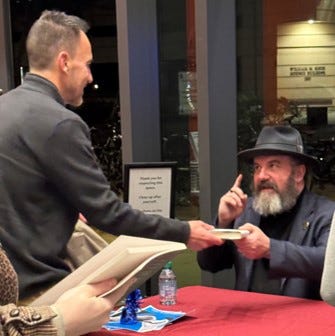
A few months back, on a visit to California, I went with Mom and Dad to see Martin Shaw at an event at Stanford, part of his tour promoting his book “Liturgies of the Wild,” which I cannot recommend highly enough if you like myth and old stories. (He was there with the very analog-seeming poet, Jane Hirshfield, also wonderful.) Though Shaw is in the tribe sounding a religious-tinged alarm about the internet, at least in part from within the internet itself (Substack, YouTube, podcasts), he is less a doomer than his pal Paul Kingsnorth, a fact both joke about. If you don’t mind the God stuff, I also recommend Kingsnorth’s “The Abbey of Misrule” Substack and his book, “Against the Machine.”
Though I’m much more temperamentally aligned with Kingsnorth and his warning about the “unmaking of humanity” — that’s the subtitle of his book and it goes on from there — as a dad, I feel compelled to at least try for some constructive optimism and pursuit of daily small pragmatic tasks. In fact, among the things I appreciate most about my own dad is just that can-do, let’s-whiteboard-this stance, which he’s taken throughout his life, no matter the professional or personal travails.
Shaw is a storyteller and appeared at the Stanford event without notes or, if memory serves, even a copy of the book, at least until the signing afterward. He says stories should “live in the jaw” (above is the one he shared that night from an earlier telling), and that if you can’t, say, tell “The Odyssey” from memory over the course of several days, which he’s done at retreats he leads, you most certainly can do something like memorize a single poem. Like many a creative soul, Shaw doesn’t fit in a tidy box, and also sketches, translates poetry and operates a press. The idea, he says, is to commit senseless acts of beauty wherever you go, including the online world, very much a place these days, not that you want to confuse it with the real world, which should always be preferred. (Shaw, from a recent post: “I’m pleased to report that the sun still seems to be rising in the east, there’s a magnificent blossom in the far field, the lambs are scampering, and The Bay Horse is still producing a magnificent pint of Jail Ale. Counterweight. Don’t forget the endless grace that’s waving across the fence.”)
All that’s to say, inspired in part by Shaw and many others besides, including all of you, posts will continue here for a while longer, with a few new twists.
Mom, in fact, did continue that additional conversation-with-the-world writing project she alludes to in post No. 123, with a series of book-length essay collections, including one, “Finding Home,” on arts and crafts, published in 2013. This may seem like prosaic subject matter, though I appreciate it in a new light, reading about and living through so much about the decline in participation in all sorts of creative pursuits and the rise of passive consumerism. I’m down on tech journalism at the moment (evaporation of real reporting in favor of personality-driven nonsense, no match for the billionaires, and so on), though Kara Swisher was right when she said that all of Silicon Valley, obsessed with apps to deliver everything, is basically assisted living for high-income Millennials. Notably that was before all this hype about AI, which seems more about replacing people than servicing them with takeout and so on, though I might be wrong.
It turns out making things that are both beautiful and useful to everyday life is yet another load-bearing wall that causes important parts of one’s humanity to come tumbling down when the alternative is, say, one-click ordering on Amazon. Plus, it’s fun to paint, and the book is about much more than that.
Ever the dabbler in online stuff and a lover of the spoken word, when “Finding Home” came out, I helped arrange a very DIY recording as an audiobook. Mom gamely participated as a reader, enduring several visits to the house by a local community college student with his gear, including sheets hung up in a low-budget effort to improve the acoustics. When the discussion came up about maybe recording another book in the collection, the answer was a polite but firm, NO. As anyone who has recorded a book knows, it’s way more tiring than it seems.
Thank you for the support and for letting us show up in your inbox.
Substack didn’t exist back then, and though the book has been on Audible and elsewhere for more than a decade, suffice it to say it’s gone essentially unnoticed and undownloaded. So, since we have two things we didn’t back then — you, a small audience of subscribers, and an easy way to distribute audio — we’re going to send out the book, 31 sections in all, via this Substack. Emails with the written essays will come as usual, with the addition of an audio player at the top if you prefer to listen rather than read. You’ll be able to listen on the Substack app, too, and perhaps as a podcast if we figure that out. We experimented with the audio in this post last year.
We hope also to put bits of the book on Instagram (sorry, Paul) in posts that may include photos of some of the paintings. As an early-onset geezer, I view the Instagram world with more than a little suspicion, though I’m intrigued by the challenge of somehow coming across the grandchildren’s feeds and phone lives. They all know, though may have forgotten, that Grandma is doing something involving a book on the internet. But words and phones don’t seem to mix, at least based on what I see in my house. When it comes to my kids anyway, I can report that it’s possible to publish more than 100,000 words across 120 posts over the course of a year and… not make the slightest dent in the awareness of teenagers, who together I’m sure spend more than 10 hours daily on their phones.
Check it out, I’ll prove it:
ATTENTION GRANDCHILDREN. IF ANY OF YOU SEE THIS, JUST SEND ME A TEXT BY THE END OF THE WEEK AND I’LL VENMO YOU $50, NO QUESTIONS ASKED. LOVE YOU GUYS!
I think my money is safe. And besides, the grip of whatever they are doing (I know some of it is Instagram Reels) isn’t their fault. They didn’t build all this stuff. The great Ted Gioia notes that, after trillions spent on AI, half of Gen Z wishes they had lived before all this stuff existed. Well played, Silicon Valley, indeed. (The grandkids are actually Gen Alpha… maybe the jury is still out for them.)
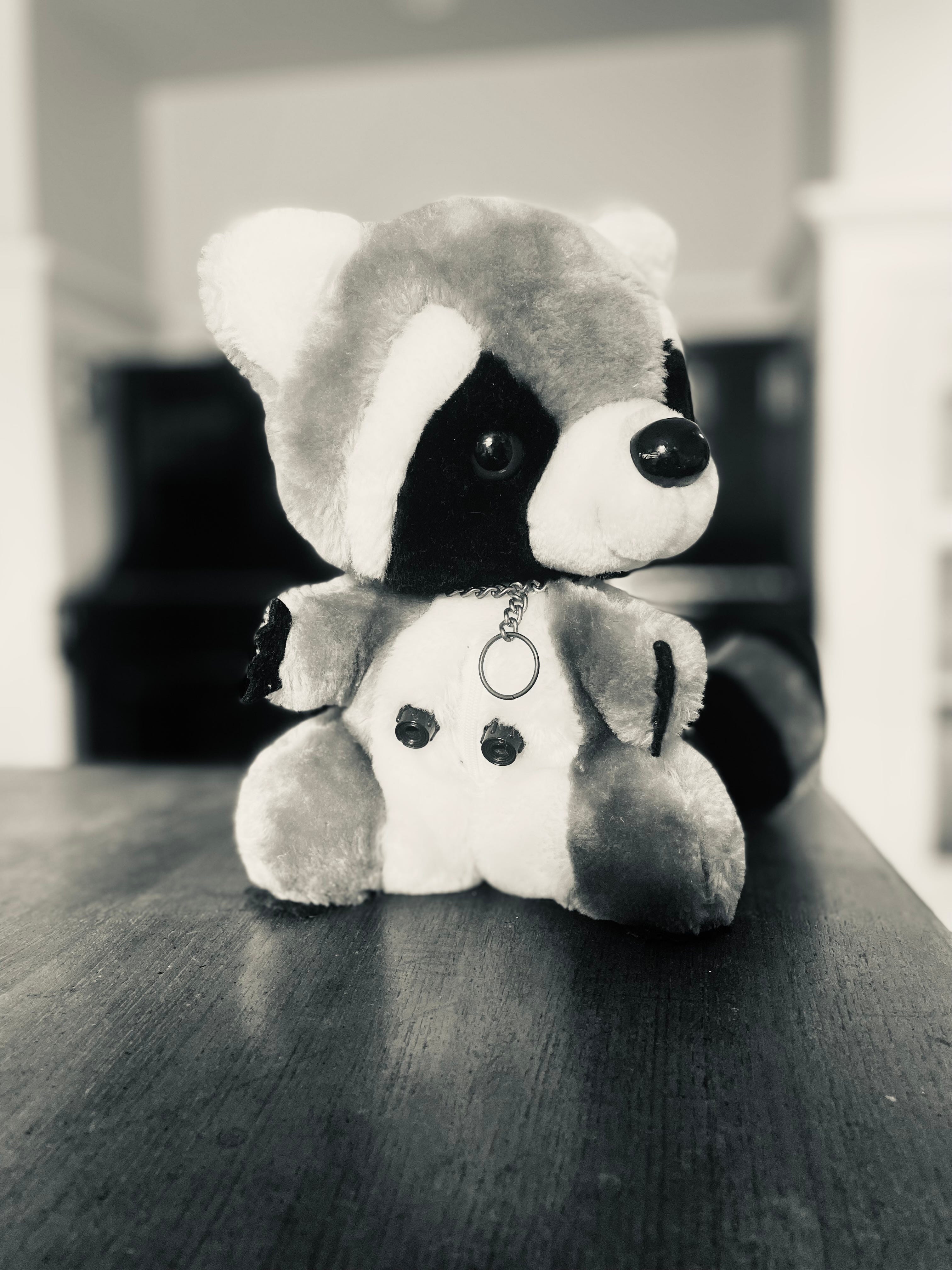
I’ve been listening to people talk through speakers and earphones for most of my life, a habit I may have picked up from my grandmother, who I remember having AM news going on a little transistor radio as she worked in the kitchen in Chula Vista. There was a second, smaller radio on her nightstand with a single-ear earphone. Among my most beloved childhood toys was Rac-key, a stuffed Radio Shack raccoon with a built-in AM radio powered by a 9-volt battery, which I sometimes could feel when I used Rac-key as a pillow. I’d go to sleep in my Walnut Creek bedroom listening to KNBR 680 broadcasts of the Golden State Warriors, which had an all-nickname backcourt of World B. Free and Sleepy Floyd.
Eventually, I graduated to talk radio. In the Northgate High years, my good friend Dave and I would cover for each other as we roamed through afternoon and weekend golf and movies and Togo’s sandwiches during a pretty stress-free adolescence. Periodically, we’d settle up our debts. Once, when the ledger was in my favor, I said, forget the cash, can we just go buy a radio? This was long before Venmo and Dave, a good friend all the way, didn’t question it. We drove to Montgomery Ward, where he plunked down cash for a radio I listened to for years after that. I did find my way to the FM dial and eventually cassettes, though my music tastes were lame by 1990s standards and skewed toward story-heavy lyrics. Another friend, Chris, regularly gave me grief about my love of Billy Joel. Chris, if you’re out there, you won’t be surprised to hear that my 14-year-old can sing along to “Vienna” and it’s sometimes in the rotation as we drive to and from swim practice. The lyrics are less alarming than what I hear in the songs she likes, though parents have always said stuff like this, I know.
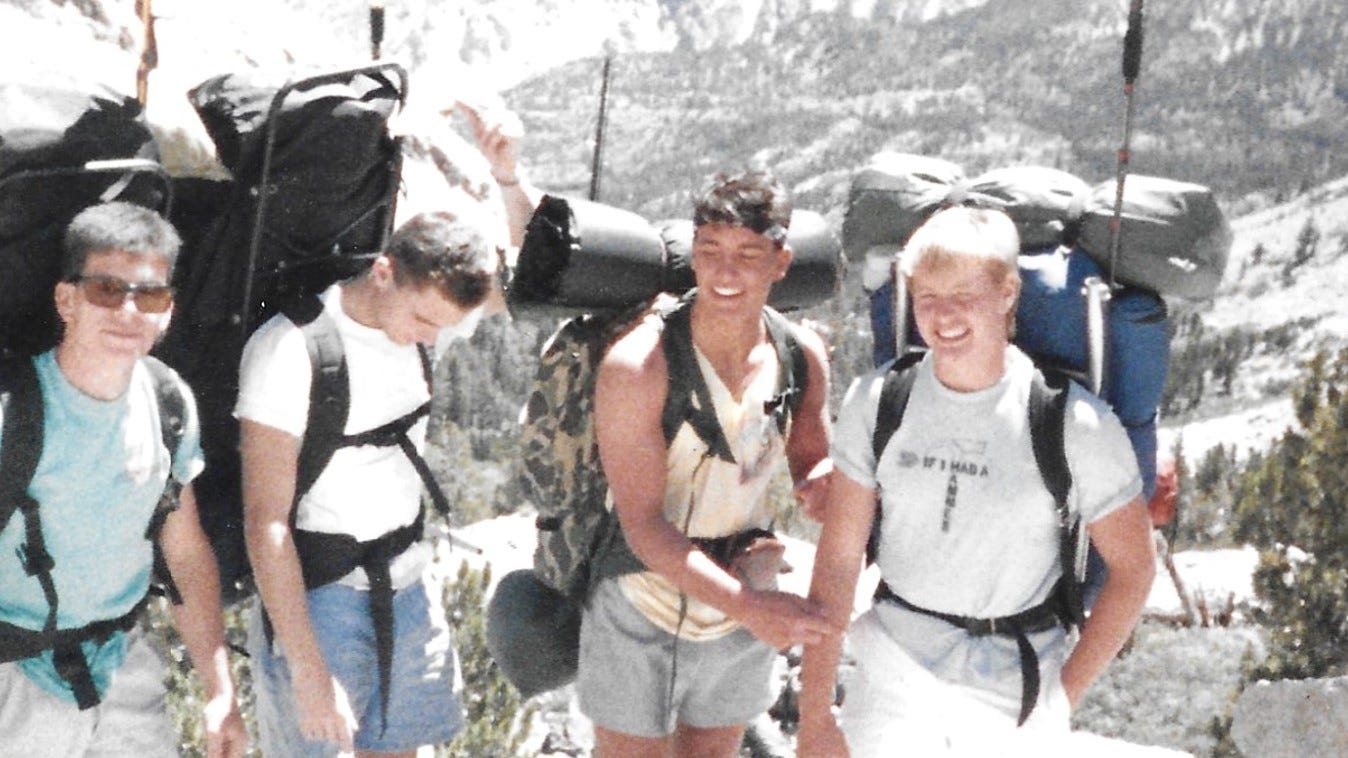
At a certain point, I discovered audiobooks, starting with the library’s collection in its bulky plastic cases, which I’d warp by leaving in the car parked in hot California parking lots for too long. In the early days of the internet, I stumbled upon a husband-and-wife team running a small online audiobook exchange. They had their own inventory, and subscribers could also swap their own titles with each other. I considered them cutting-edge not only for their use of a very Web 1.0 ordering system, but also for including CDs alongside cassettes. I was working at Intel at the time and remember tracking down someone in Intel Capital and breathlessly going through the reasons why the exchange, which might have been based in Vermont and operated with a vaguely socialist, no-profit vibe of the tool lending library at a neighborhood church, was going to be the next IPO juggernaut and was a huge opportunity.
Suffice it to say, I never would have made it as a venture capitalist, though, unfortunately, I still occasionally listen to them, as they seem to be overrepresented on the podcast landscape, which commands most of my listening attention these days. Recently, I heard one of these VC stars say the whole idea of datacenters in space — apparently an actual thing — will be useful as a backup internet when governments on earth inevitably collapse and society breaks down. They always sound so nonchalant when they say such things and since their batting average seems to be above the Mendoza Line, there’s at least some reason to worry. I’ll note that if this comes to pass, at least some of Mom’s book collection, including the audiobook, will be up there in orbit, too, even if no one’s around to read or listen except for Elon’s robots on Mars.
We’ll start sending “Finding Home” essays out shortly, probably on the same twice-weekly schedule. If you happen to have stuck around for, say, the De La Salle history, and essays on arts and crafts aren’t really your thing, no hard feelings should you wish to unsubscribe. If you need help doing that, just send a note. (And if you have any arts and crafts lovers in your life, please consider forwarding this to them.) Thanks again for reading, and maybe listening, and if you happen to see the grandkids, tell ‘em their grandmother is coming to Instagram.