

01. ✷ "River Journeys" Preface

Each thing she learned became a part of herself,
To be used over and over again in new adventures.
-Kate Seredy, “Gypsy,” 1951
Robert Frost observed, “Education is hanging around until you’ve caught on.” One lesson I’ve learned after a life in school and a few harrowing catastrophes with assignments, lesson plans, speeches and even dinner party menus I thought I could just whip out because, after all, I had at least been thinking about what I wanted to say or do or cook, is that the distance between the idea and the reality was usually a much longer jump than I imagined. T.S. Eliot noted much the same thing about life in general when he said, “Between the idea and the reality/ Between the motion and the act/ Falls the shadow.”
One of the defining loves of my life is reading, the intimate partner of writing. A day when I don’t read always is a bit smaller than days that include the magic genie of print. I had been entertaining the idea for some time of doing some writing myself to see if I could turn the elusive memories and ideas tucked in the shadows of yesterday into something that could be read and shared today and tomorrow. But getting from the idea of writing to the reality of writing was a deceptively wide gap, as usual.
Several events prompted me to begin now. Some influences were public, others private. Publicly, we lurched into a new century and already have endured some sea changes in our public life: 9/11, the rise of new world powers resulting in a landscape a bit flatter than before (at least if Thomas Freidman is right), the blurring of lines between work and home thanks to technology and economic realities, and perhaps new definitions of what “family” means. As I considered these and other social shifts, the gap between America at the end of World War II (when I entered the scene) and the world I experience today seems galaxies apart. Or is it? It was time to consider another lesson I learned in school… you’ll never know what you really think unless you write it down. And rewrite it, continuing until the words start to capture your thoughts. In writing, two things happen: you shape the words and they shape you as well.
A second public influence was the retirement of Tom Brokaw, the longtime NBC News anchor in 2004. His tenure stretched to the days when most of the United States actually watched a nightly national news program. Before that he had been the anchor of the Los Angeles local news during the years we lived there in the late l960s. He was my favorite commentator in the mold of men I remembered from my childhood… Chet Huntley, David Brinkley and Eric Severeid. As we moved from place to place, Tom (since he was in our home most weekday evenings, for years I felt he was just “Tom”) was always the same… steady for three decades. He didn’t seem to age, so when he announced several years ago that, at age 64, he was stepping down “to have more time to think about fewer things,” I was both surprised and uneasy.
I wasn’t watching him much the last years, but his leaving seemed to make the rather sinister “gray eye” of the television that brooded in the family room even gloomier. But his reason (more time… fewer things) was wildly appealing to me. I, too, was longing by the late l990s for exactly the same thing… more time. It had been a bone wearying long-distance run through more than half a century. But a longing for change wasn’t enough to make change happen. I felt like Dorothy’s companions in the “Wizard of Oz.” I needed the lion’s courage, the scarecrow’s brain and some good fortune to even have a choice. I knew the wizard wasn’t going to be the answer.
I continued my university teaching and supervising. The teaching remained invigorating (something I will write more about later), but the site supervising meant traveling long distances on California’s crowded highways to far-flung school districts from Dixon in the east, to Petaluma in the north, to Fremont in the south, to San Francisco in the west and most of the overlapping jurisdictions in between. I was meeting with school administrators struggling to keep up with California’s licensing requirements while trying to keep their schools running as well. I became more and more convinced that bureaucratic licensing wasn’t the answer to our schools’ leadership challenges.
Gail Sheehy’s book, “Passages,” also influenced me. A blockbuster in the 1970s, her message had been a cautionary flag both when I first read it and later on. She suggested that success in life is not finding yourself in middle age at the end of a passage leading to a future you don’t want. Her emphasis was on making authentic personal choices, not merely socially driven ones. During the years of growing up, raising a family, creating a home, finishing academic degrees and working, there hadn’t been time for many introspective choices. But now could be that time. It was a tantalizing thought… and a scary one.
The final influence on my decision to begin writing was a private one. One of my oldest friends, Jack O’Leary, mentioned that his wife, Honey, was writing her life story for her grandchildren. I thought it was a great idea. By that time I had “screwed my courage to the sticking place” (Lady Macbeth), taken a deep breath and had left the university. I had spent almost my entire life in and around all manner of schools, so leaving meant drawing on some of the lessons I had learned through my life… a life filled with many “leavings.”
Leaving the formal workplace is more than leaving just the security of a place. Increasingly, it is where people have a significant part of their identity. It is a place where one can connect in safe ways with the quiet drama and melodrama of lives lived around the copy machine… a machine that is itself becoming obsolete. Of course, it is also a place where one gets paid for what they do, and the economic paradigm within which we live is a very powerful one. It is a socially constructed world, and a fleeting one for everyone, but for brief moments in the arc of many life stories, the workplace gives meaning and structure, however artificial, to the business of living.
Nonetheless, I was determined to make a change. As the poet Andrew Marvell put it, “At my back I always hear/Time’s winged chariot hurrying near.” I wanted to make sure, like Thoreau, that when I got to the end I hadn’t missed some living along the way. I wanted to experience a different rhythm and a different routine, and to return to some of the quiet, independent, book-filled days that had been so much a part of my early life.
I persuaded Honey to send me her autobiography. It was a fascinating account of a young girl raised in a staunchly conventional Catholic home, who becomes a nun, but then embarks on an entirely different journey. The social changes were remarkable, both for her and the country. Reading it was the boost I needed to begin my own recollections of what it was like growing up in a Navy family, in a world where the social norms were very clear and the country was optimistic in the wake of World War II. I find myself now in a more colorful, disorganized, and sometimes more despairing time, where the path is less clear for women, for families and for the country itself.
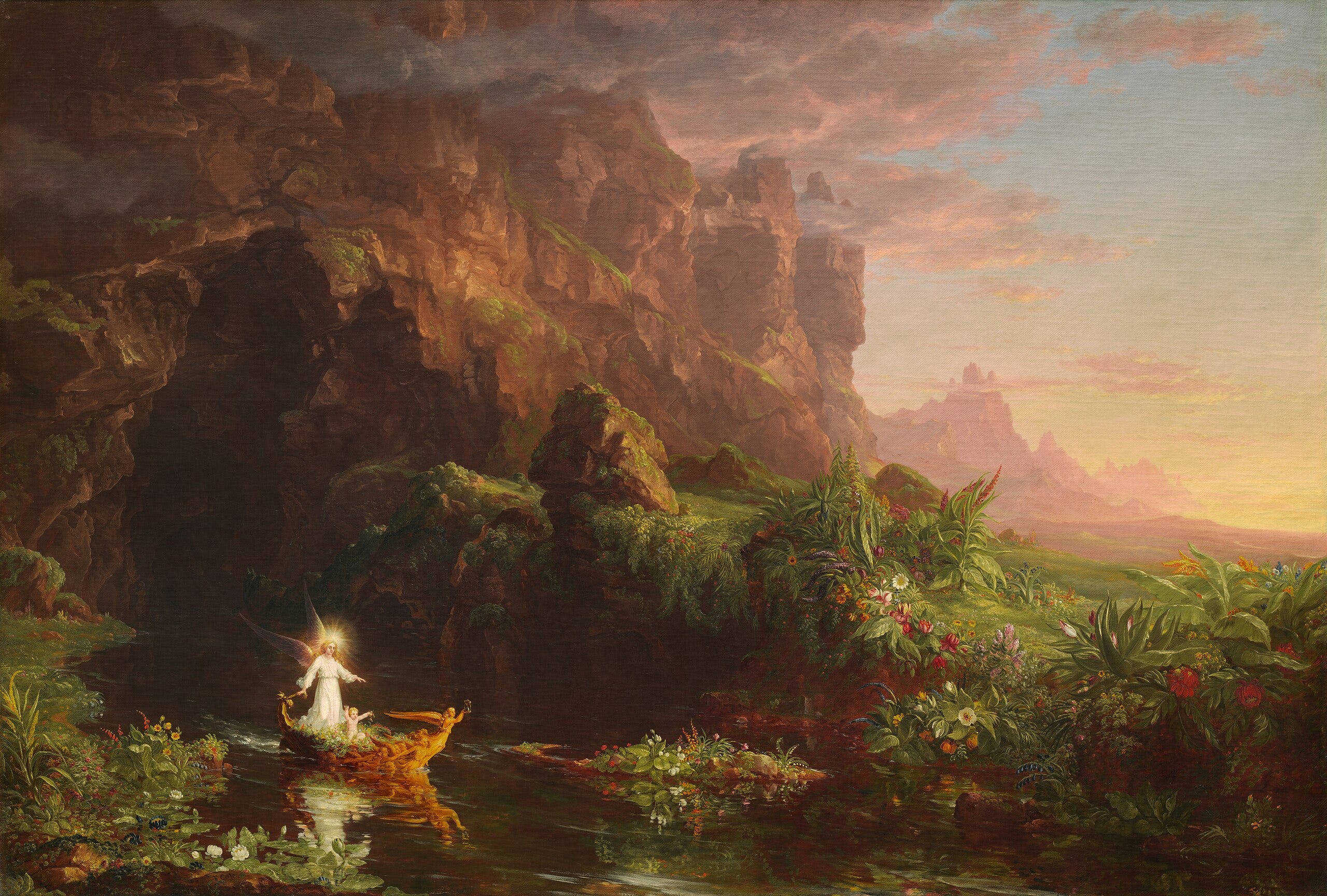
The first challenge was figuring out how to organize my story. After considering and rejecting Shakespeare’s Ages of Man (too many), Buddha’s Stages of Being—Morality, Concentration, and Wisdom (too esoteric), and Margaret Mead’s Three Stages of Womanhood (too few), I found myself gazing one afternoon at Thomas Cole’s allegorical paintings “The Voyage of Life.” The paintings follow a voyager who travels in a boat on a river through the American wilderness. The four stages of the voyage: childhood, youth, adulthood and old age, as the little boat progresses from a tranquil narrow stream to a much wilder and larger river, seemed exactly right.
Part One includes some of my childhood remembrances. Characterized by much geographic relocation, those experiences are the foundation of all that follows. Part Two is my remembrances of high school, college and falling in love. Part Three is Adulthood and covers the period from l969-l999. Part Four is a series of essays and reflections.
Willa Cather once observed wryly that there are only two or three human stories and they go on repeating themselves as fiercely as if they had never happened before. I am not convinced she is right, since we all hope our story is, after all, only our story. But it is stories, unique or ordinary, that bind us together. What follows is a glimpse into my small piece of that chain that connects us all.
Anne Ayers Koch
January 2009